Retail Banking Customer Segmentation Using RFM Analysis
Not every account holder is an engaged customer — do you know the difference?
Problem Statement
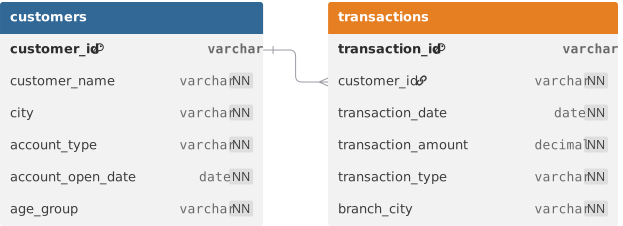
NexaBank is a mid-sized retail bank operating across five branches in major Indian cities — Mumbai, Delhi, Bangalore, Chennai, and Pune. Over the past two years, NexaBank has maintained a growing base of approximately 1,200 retail account holders spanning savings accounts, current accounts, and salary accounts. Transaction volumes have been healthy, with over 20,000 transactions recorded between January 2023 and December 2024. However, the Head of Retail Banking has raised a persistent concern in the last three quarterly reviews: NexaBank's relationship managers are spending equal time and effort on all customers regardless of their actual banking activity, and the bank has no systematic way of identifying which customers deserve priority attention.
The bank suspects that a significant share of account holders have become functionally dormant — accounts that were opened but see little to no regular transaction activity. At the same time, a smaller group of highly active customers is likely generating a disproportionate share of transaction volume and fee revenue. Without a formal customer activity framework, NexaBank cannot design targeted engagement programmes, cannot prioritise relationship manager workloads, and cannot identify early warning signs of customer disengagement. You have been engaged as a data analyst to build NexaBank's first customer segmentation model using two years of transaction history. Your task is to apply RFM analysis — a proven, formula-based segmentation technique used widely in retail banking — to classify every account holder into one of three engagement segments: Premium, Standard, or Dormant. The output will directly inform NexaBank's Q1 2025 customer engagement strategy.
Stakeholder Requirements
--RFM Score Calculation: For each customer, compute three metrics using all transactions up to the reference date of 31 December 2024: Recency (days since last transaction), Frequency (total number of transactions), and Monetary (total transaction amount in INR). Then assign an individual score of 1, 2, or 3 to each metric using percentile-based thresholds, and sum them into a single RFM Score (range: 3–9). Higher scores indicate more engaged customers.
--Segment Classification & Summary: Classify each customer into one of three segments based on their RFM Score — Premium (score 7–9), Standard (score 4–6), or Dormant (score 3). Report the count and percentage of customers in each segment, along with the average Recency, Frequency, and Monetary value per segment to characterise each group.
Domain Understanding
Retail Banking Customer Engagement
Retail banks face a unique challenge compared to e-commerce businesses: customers rarely formally "leave" — they simply stop engaging. An account can remain open for years with near-zero activity while the bank continues to bear the cost of account maintenance, regulatory compliance, and periodic communication. This creates a significant hidden cost burden from dormant accounts, estimated by industry analysts to represent 20–35% of the retail customer base at a typical mid-sized bank. At the same time, highly active customers — those who transact frequently, maintain higher balances, and use multiple banking products — generate the bulk of fee income, cross-sell revenue, and referral activity. Identifying and differentiating these two extremes is the foundational step in any retail banking customer strategy, and RFM analysis is the standard first tool used for this purpose across banks of all sizes.
Critical Metrics & Calculations
Three metrics form the RFM framework in a retail banking context:
-
Recency (R): Days since a customer's most recent transaction, measured from a fixed reference date. Formula:
Recency = Reference Date − MAX(transaction_date) per customer. Lower recency = more recently active = higher engagement. In scoring, lower recency gets a higher score (3 = most recent, 1 = least recent). -
Frequency (F): Total number of transactions completed by a customer within the analysis period. Formula:
Frequency = COUNT(transaction_id) per customer. Higher frequency indicates stronger banking habit and deeper product engagement. Higher frequency gets a higher score. -
Monetary (M): Total value of transactions processed through the customer's account. Formula:
Monetary = SUM(transaction_amount) per customer. In retail banking, this reflects overall account activity volume and is a proxy for relationship depth. Higher monetary value gets a higher score. -
RFM Score: The sum of individual R, F, and M scores, each ranging from 1–3. Formula:
RFM Score = R_score + F_score + M_score. Range: 3 (least engaged) to 9 (most engaged). Segment thresholds: Premium = 7–9, Standard = 4–6, Dormant = 3.
Business Logic & Trade-offs
One important nuance in banking RFM analysis is that all transaction types contribute to activity measurement — debits, credits, ATM withdrawals, and transfers all signal that a customer is actively using their account. This differs from e-commerce LTV analysis where only revenue-generating transactions are counted; in banking, the goal is measuring engagement, not just revenue. When scoring RFM dimensions using percentile-based thresholds (e.g. top 33% get score 3), the thresholds adapt to the actual data distribution rather than using arbitrary fixed numbers — this makes the segmentation robust even when data volumes vary across branches or time periods. One trade-off to be aware of: a customer who made one very large transaction recently might score high on Recency and Monetary but low on Frequency, landing them in Standard despite being a high-value relationship. This is why all three dimensions together tell a more complete story than any single metric alone.
ER Diagram
Loading the interactive workspace...