
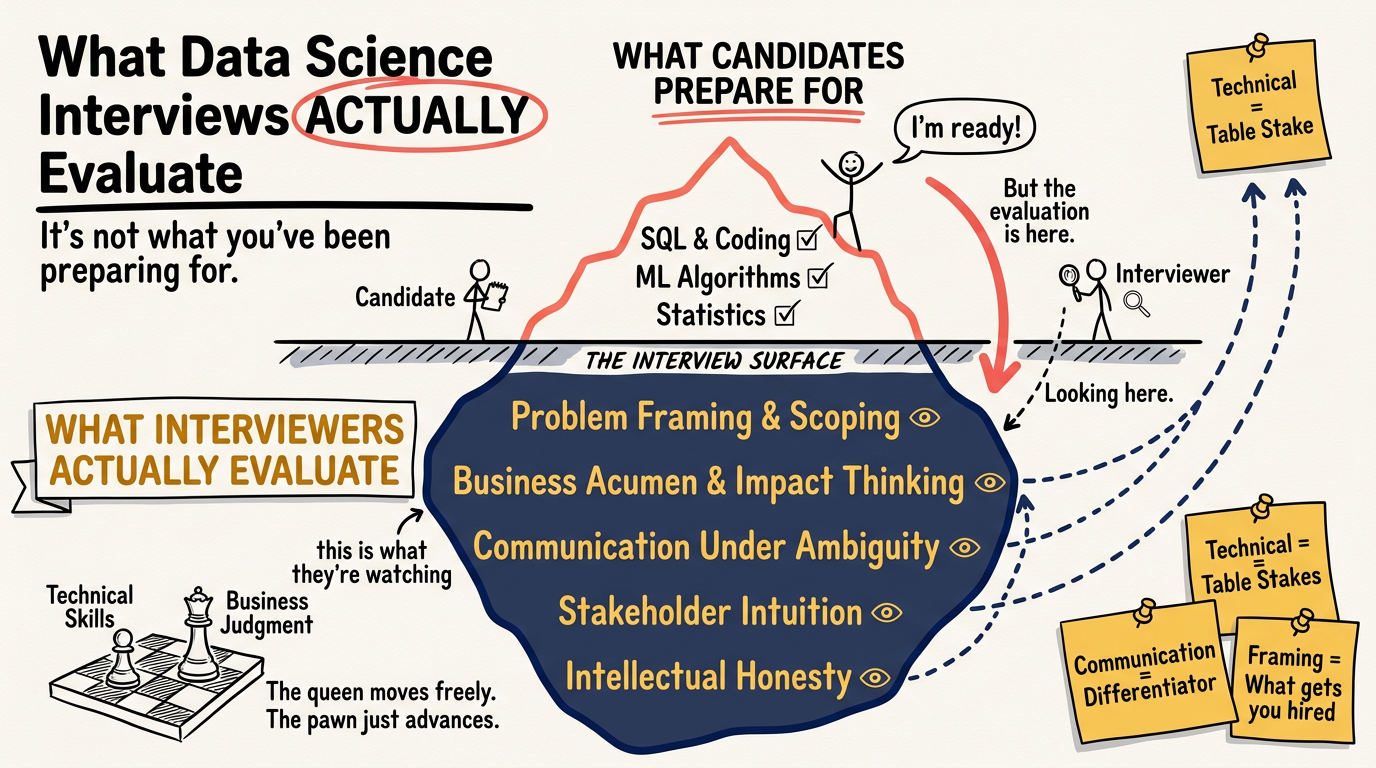
The Preparation Paradox
Open any data science interview guide. You'll find hundreds of SQL puzzles, probability brain-teasers, ML algorithm explanations, and coding challenges. Candidates grind LeetCode for weeks. They memorize the math behind gradient descent. They practice explaining the bias-variance tradeoff until they can recite it in their sleep.
Then they get rejected — and they have no idea why.
Here's the uncomfortable truth: technical proficiency is the floor, not the ceiling. Interviewers assume you can write a query and build a model. What they're actually trying to figure out is whether you can think like a business partner, communicate like a scientist, and navigate ambiguity like a professional.
This article decodes the real evaluation criteria across every stage of a data science interview — and how to prepare for what actually matters.
Stage 1: The Phone Screen — They're Not Testing Your Knowledge
The recruiter or hiring manager screen isn't a technical gatekeeping call. It's a communication audit.
They're asking themselves:
What Most Candidates Do Wrong
They answer questions like "Tell me about a project you worked on" with a technical monologue. They talk about the algorithm they chose, the cross-validation strategy, and the AUC score. The interviewer's eyes glaze over.
What Actually Works
Structure every project story around a business narrative, not a technical one:
Technical details are supporting evidence, not the story itself. If your interviewer is a recruiter, they should be able to follow your narrative. If they're a data scientist, they'll ask for technical depth when they want it.
Stage 2: The Technical Screen — They're Testing How You Think, Not What You Know
Here's the insight that changes everything: technical questions in data science interviews are proxies for problem-solving process, not knowledge retrieval.
When an interviewer asks you to write a SQL query to calculate 7-day rolling averages, they're not primarily checking if you know window functions. They're watching:
The Silent Killer: Competent But Uncommunicative
Many technically strong candidates fail this stage because they go quiet when they think. They write perfect code — in silence. The interviewer has no window into their process. This reads as opaque, not impressive.
The Winning Pattern
Before writing a single line of code or SQL:
This process signals exactly what data science looks like on the job: methodical, communicative, and self-correcting.
Stage 3: The Case Study / Take-Home — They're Grading Your Judgment, Not Your Model
The take-home assignment is where the most counterintuitive evaluation happens. Candidates build complex models, tune hyperparameters, and produce beautiful Jupyter notebooks. Then they wonder why someone with a simpler model got the offer.
The Dirty Secret of Take-Home Evaluations
Reviewers spend a fraction of the time on your model that you spent building it. What they actually read carefully:
The Framing Formula That Works
Open every case study with a one-paragraph section called "Problem Restatement" that answers:
Close every case study with a section called "Limitations & Next Steps" that demonstrates:
This structure alone puts your submission in the top 10% — not because of the math, but because of the thinking.

Stage 4: The Onsite — They're Testing for Partnership, Not Performance
By the onsite, they already know you can do the technical work. The onsite exists to answer one question: "Is this someone I want to collaborate with for the next two years?"
This translates into three observable behaviors interviewers look for:
1. How You Handle Pushback
At some point, an interviewer will challenge your answer or methodology — even if it's correct. This is deliberate. They want to see:
The correct response to pushback is: "That's a fair point — let me think about it. I see the concern with my approach there. However, I still think X because Y. Would you see a different tradeoff?"
2. How You Contextualize Your Work
Every data scientist is embedded in a business. The best candidates demonstrate awareness of the ecosystem around them:
If you only ever talk about your data and your model, you're presenting yourself as a technician. If you talk about the decision-makers, the end users, and the organizational context — you're presenting yourself as a partner.
3. Your Questions at the End
"Do you have any questions for us?" is not a formality. It's an evaluation. Strong candidates ask:
Weak candidates ask about salary (save it for the recruiter) or say "Nope, I think you covered everything" (signals disengagement).
The Meta-Skill Behind All of It: Structured Communication
If there's one thing that unifies every evaluation criterion above, it's structured communication under pressure.
Data science is a translation profession. You translate business problems into analytical questions, raw data into decisions, and statistical outputs into recommendations. Every interview is testing whether you can do that translation fluently.
The good news: this is a learnable skill. Here's a practice framework:
The "3-Layer" Answer Framework
For any non-trivial interview question, structure your answer in three layers:
| Layer | What You're Doing | Example |
| Layer 1: The Bottom Line | State your conclusion first | "My recommendation is to use a simpler logistic regression here." |
| Layer 2: The Reasoning | Walk through your logic | "Because the decision boundary is likely linear given the feature distributions, and interpretability matters for this use case." |
| Layer 3: The Caveats | Acknowledge what you're assuming | "This holds if the class imbalance stays below 10:1 — if not, I'd revisit the approach." |
This structure communicates clarity, confidence, and intellectual honesty simultaneously. It's how senior data scientists talk, and it's what interviewers at every stage are trained to listen for.
What "Business Sense" Actually Means in Practice
"Business acumen" sounds vague. Here's what interviewers are concretely looking for:
1. You know what a metric is for, not just what it measures. Don't just say "I optimized for precision." Say "I prioritized precision over recall because in this fraud use case, a false positive costs us a customer relationship — which is more expensive than a missed fraud case."
2. You can think about the second-order effects of your model. What happens when your churn model is right? Who acts on it? What do they do? What happens if they follow the recommendation for the wrong customer?
3. You anchor insights to decisions. A data scientist who says "I found that users who engage in the first 48 hours have 3x higher LTV" is fine. A data scientist who adds "...so I recommended we redesign the onboarding flow to surface the core feature within 24 hours, which we A/B tested and validated" is the one who gets hired.
Final Word
The data science job market is more competitive than ever. The candidates who stand out aren't the ones who have memorized the most algorithms — they're the ones who can walk into a room with ambiguous data, unclear objectives, and skeptical stakeholders, and come out the other side with a clear recommendation and a credible path forward.
That's what interviews are trying to find. Prepare accordingly.