
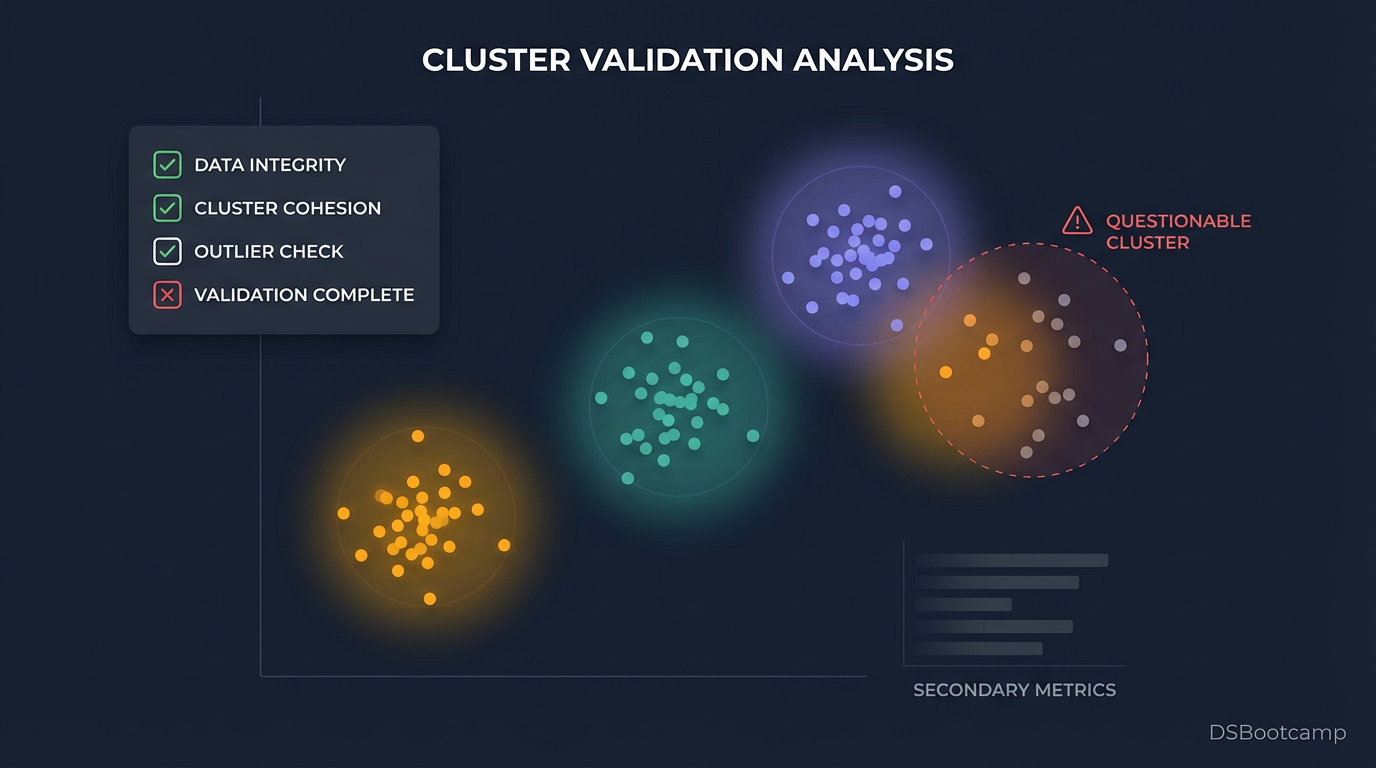
Step-by-step: choosing k, silhouette scoring, profiling each cluster, stress-testing stability, and the business sense check before you present.
Clustering is one of the most commonly misused techniques in applied data science. Not because people apply the wrong algorithm — but because they skip the step that matters most: figuring out whether the clusters they found are real, stable, and meaningful, or whether they're just mathematical artifacts that look convincing on a scatter plot.
The uncomfortable truth is that k-means will always give you k clusters. It has no mechanism to tell you "actually, there's no meaningful structure in this data." Neither does hierarchical clustering, DBSCAN's epsilon tuning, or Gaussian mixture models. The algorithm will always produce output. Your job — before you name a cluster "High-Value Loyalists" and present it to a VP — is to rigorously determine whether that output deserves a name at all.
This is that checklist.
Step 1: Choose k with Evidence, Not Instinct
The most common mistake in clustering work is picking k based on what seems reasonable before running a single model. "We have three customer types" is a business hypothesis, not a data-driven choice of k. Starting there anchors the entire analysis to an assumption that may not reflect what the data actually supports.
Run the algorithm across a range of k values — typically k=2 through k=10 for most business problems — and evaluate two metrics at each value.
The Elbow Method plots within-cluster sum of squares (WCSS) against k. As k increases, WCSS always decreases — adding more clusters always reduces the average distance between points and their centroids. What you're looking for is the point where the rate of decrease sharply drops off — the "elbow" — suggesting that additional clusters are capturing noise rather than genuine structure.
from sklearn.cluster import KMeans
import matplotlib.pyplot as plt

wcss = []
K_range = range(2, 11)

for k in K_range:
    model = KMeans(n_clusters=k, random_state=42, n_init=10)
    model.fit(X_scaled)
    wcss.append(model.inertia_)

plt.plot(K_range, wcss, marker='o')
plt.xlabel('Number of Clusters (k)')
plt.ylabel('WCSS')
plt.title('Elbow Method')
plt.show()
The Silhouette Score (covered in more depth in Step 2) gives you a single scalar per k value that measures cluster quality. Plot it alongside the elbow curve. The best k is often the one where the silhouette score peaks while the elbow curve inflects. When these two signals agree, you have a defensible choice. When they disagree, investigate both candidate values before committing.
The point isn't to find the "mathematically correct" k — it's to find the k that represents a genuine structural break in the data and produces clusters interpretable enough to act on.
Step 2: Silhouette Scoring — Per Cluster, Not Just Overall
Most practitioners compute the mean silhouette score across all samples and move on. This is a mistake. The mean can look acceptable while hiding a cluster that is nearly indistinguishable from its neighbors — which means one of your segments doesn't really exist as a discrete group.
The silhouette score for a single data point measures how similar it is to its own cluster relative to the nearest neighboring cluster:
s(i) = (b(i) - a(i)) / max(a(i), b(i))
Where a(i) is the mean distance to all other points in the same cluster, and b(i) is the mean distance to all points in the nearest different cluster. Scores range from -1 to +1. Values near +1 mean the point is well inside its cluster. Values near 0 mean it sits on a boundary. Negative values mean it's likely misassigned.
The diagnostic you actually want is a silhouette plot — a bar chart of individual silhouette scores grouped by cluster, sorted within each cluster. Healthy clusters have most bars extending well past 0.4, with few negative values. A cluster where the majority of bars hover near zero is telling you that segment doesn't have a distinct center — it's a blob that bled into its neighbors.
from sklearn.metrics import silhouette_samples, silhouette_score
import numpy as np

labels = model.labels_
silhouette_vals = silhouette_samples(X_scaled, labels)
avg_score = silhouette_score(X_scaled, labels)

print(f"Mean Silhouette Score: {avg_score:.3f}")

# Per-cluster average
for cluster in np.unique(labels):
    cluster_sil = silhouette_vals[labels == cluster].mean()
    print(f"  Cluster {cluster}: {cluster_sil:.3f}")
A rule of thumb: any cluster with a mean silhouette score below 0.25 should be treated with serious skepticism. Below 0.15, treat it as noise until proven otherwise.
Step 3: Profile Each Cluster Until It Has a Story
A cluster that can't be described in one plain-English sentence isn't ready to present. Profiling is the step where you translate mathematical groupings into business meaning — and where you often discover that two clusters are actually the same segment, or that one cluster is driven entirely by a single outlier feature you didn't intend to cluster on.
For each cluster, compute the mean (or median for skewed features) of every input feature, then compare it to the overall dataset mean. Express the difference as a z-score or percentage deviation so features on different scales are comparable.
import pandas as pd

df['cluster'] = model.labels_

profile = df.groupby('cluster').mean()
overall_mean = df.mean()

# Deviation from overall mean
deviation = (profile - overall_mean) / overall_mean * 100
print(deviation.round(1))
Read each cluster's profile as a character description. Cluster 0 spends 40% more than average, visits twice as frequently, but has a below-average basket size — that's a frequent small-basket shopper, distinct from Cluster 2 which visits rarely but spends 3x the average per trip. Those are real behavioral segments. If your profile table shows three clusters with nearly identical feature means, different k values or a different feature set will likely produce more meaningful results.
Also check: is any single feature dominating the cluster assignments? If one feature has dramatically higher variance than others and you didn't scale properly, k-means will cluster almost entirely on that variable. This is a data preparation problem masquerading as a modeling result.
Step 4: Stress-Test Stability
A cluster solution that changes dramatically when you modify the data slightly is not a reliable finding — it's a fragile coincidence. Stability testing is the step most junior analysts skip and most senior analysts consider non-negotiable.
Run three stability tests:
Bootstrap resampling. Run your clustering on 80% of the data, randomly sampled, 20–30 times. For each run, assign the held-out 20% to the nearest centroid and compute the cluster membership overlap with the full-data solution. Stable clusters show high consistency (>85% membership overlap) across bootstrap runs. Unstable clusters shuffle composition significantly across runs.
Random seed sensitivity. K-means is sensitive to centroid initialization. Run the same k on your full dataset with 10–20 different random seeds. If the cluster assignments are meaningfully different across seeds, your clusters are sitting in a flat region of the objective function — there's no strong attractor pulling the solution toward a consistent structure.
Feature perturbation. Add a small amount of Gaussian noise to your features and rerun. Real structure in the data should survive mild perturbation. Clusters that dissolve when you add noise to features were probably reflecting data artifacts rather than genuine groupings.
If your solution fails two or more of these tests, treat it as preliminary. Surface it as exploratory analysis, not a definitive segmentation.
Step 5: The Business Sense Check
This is the step no algorithm can perform. Before you present cluster results to a stakeholder, you need to answer five questions honestly:
Can you act on each cluster differently? If the recommended action for Cluster A and Cluster B is identical, the segmentation adds no value regardless of how mathematically clean it is. Clusters are useful when they imply distinct decisions.
Do the clusters have meaningfully different sizes? A cluster containing 2% of your customers is rarely actionable at scale. A cluster containing 60% of customers alongside one containing 5% probably means you need to refine the segmentation, not present it.
Does each cluster make intuitive sense to domain experts? Show the profiles to a category manager, a merchant, or a customer insights manager who knows the business. If they look at the feature means and say "that doesn't describe any customer I recognize," listen carefully. They might be wrong — or the cluster might be a data artifact.
Are the clusters stable over time? Run the same approach on data from a different time period and check whether the same segments emerge. If your "High-Value Loyalist" cluster only appears in Q4 data, it's a seasonal pattern, not a stable segment.
Can you name each cluster in five words or fewer? "Cluster 3" is not a business deliverable. "Infrequent High-Spend Occasion Shoppers" is. If you can't name it, you haven't profiled it deeply enough yet.
The Checklist at a Glance
Before presenting any cluster analysis:
[ ] Ran clustering across multiple k values with elbow + silhouette evidence
[ ] Reviewed per-cluster silhouette scores, not just the mean
[ ] Profiled every cluster with feature deviation from overall mean
[ ] Confirmed no single feature is dominating assignments (check scaling)
[ ] Passed bootstrap stability test (>85% consistency)
[ ] Passed random seed sensitivity check
[ ] Each cluster has a plain-English name and a distinct recommended action
[ ] Cluster sizes are operationally meaningful
[ ] Domain expert review completed
[ ] Temporal stability confirmed on a separate time period
Ten checks. Most analyses that get presented to business stakeholders have passed two or three of them. The ones that drive real decisions — the ones that actually change how a business treats its customers — have passed all ten.
That's the difference between a clustering exercise and a clustering result.
This post is part of DSBootcamp's Fundamentals series, where we cover the concepts every data scientist needs to know — with the rigor and real-world context that production work actually demands.